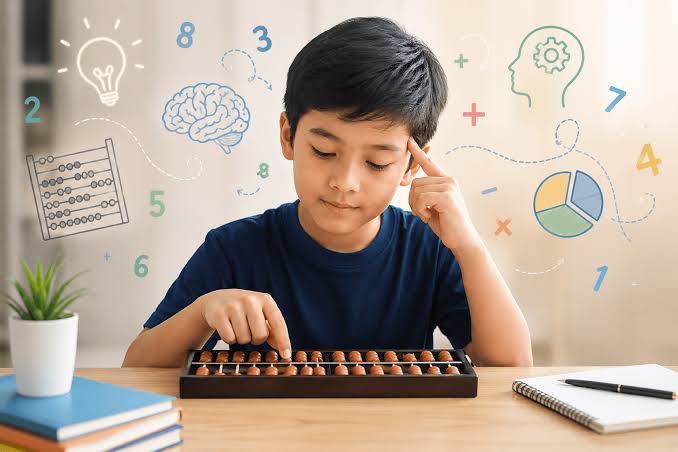
Children today are growing up surrounded by technology. Smartphones, educational apps, calculators and artificial intelligence tools can solve mathematical problems in seconds. With so many digital resources available, many parents naturally wonder whether traditional learning tools like the abacus are still relevant.
Is spending time learning to move beads on a calculating frame really useful when a calculator is just one tap away?
The answer is yes, when abacus learning is taught as a structured skill-building activity rather than simply a way to compete with calculators.
An abacus does not exist to replace modern technology. Its purpose is to help children understand numbers, practise calculations and gradually develop the ability to solve arithmetic problems mentally.
The Japanese Soroban method, in particular, gives children a visual and practical way to work with numbers. As they progress, they learn to imagine the abacus in their minds and perform calculations without physically moving the beads.
At a time when parents are looking for meaningful activities beyond screen-based entertainment, abacus learning remains an interesting educational option.
1. What Is Abacus Learning?
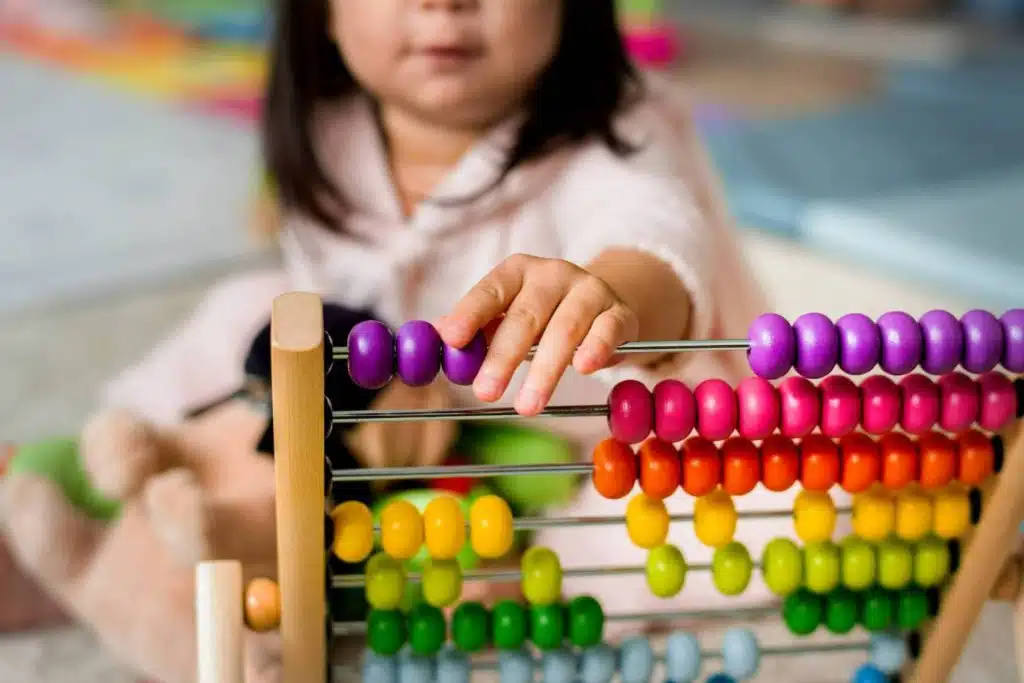
An abacus is a traditional calculating tool made up of rods and movable beads. Each rod represents a place value, such as ones, tens, hundreds and thousands.
Instead of memorising calculations alone, children learn to represent numbers physically using beads.
For example, to represent the number 25, a child learns how to show two tens and five ones on the abacus.
This visual approach helps connect abstract mathematical symbols with something children can see and manipulate.
In Japanese Soroban training, students gradually learn more complex calculations involving:
Addition and subtraction
Multiplication
Division
Place value and number representation
Multi-digit mental calculations
As students become more experienced, they practise visualising an imaginary abacus and mentally moving its beads. This skill is commonly known as abacus-based mental calculation.
2. Why Is Abacus Learning Still Relevant in 2026?
Technology has made calculations easier, but understanding how numbers work is still an important part of mathematics education.
A calculator gives an answer. An abacus learning programme gives children an opportunity to practise the steps involved in reaching that answer.
Here are some reasons why parents may still consider abacus training valuable.
A. It Encourages Active Learning
Children learn more actively when they can interact with what they are studying.
Moving beads, representing numbers and changing their positions make arithmetic more visual and practical.
Rather than seeing mathematics only as numbers written in a notebook, children can explore how numbers are formed and how calculations work.
B. It Builds Mental Calculation Practice
As children progress from physical bead movement to mental visualisation, they practise solving calculations without depending on a physical tool.
This can help them become more comfortable with everyday arithmetic and numerical problem-solving.
C. It Provides a Different Type of Learning Activity
Many children spend considerable time using phones, televisions and computers.
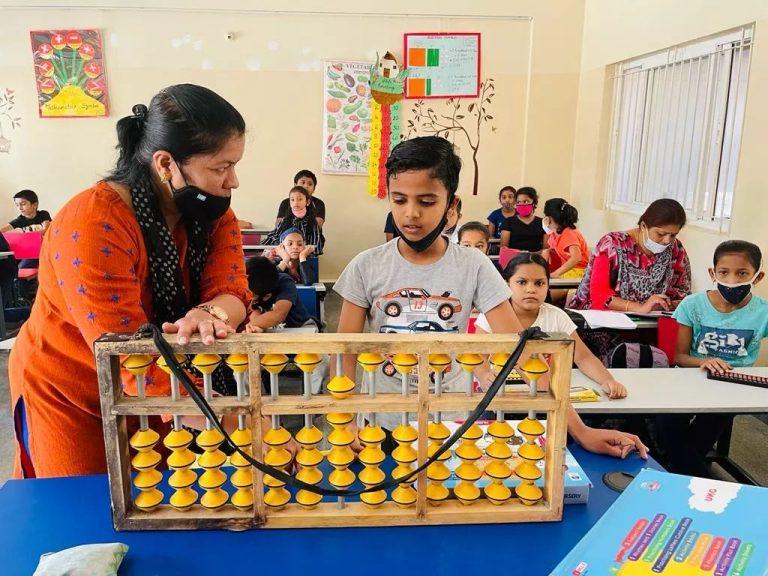
A classroom activity involving physical materials, teacher guidance and regular practice can provide a different learning experience.
Abacus classes can also introduce structured challenges, worksheets, group activities and friendly competitions.
D. It Encourages Consistent Practice
Like learning a musical instrument, a sport or a new language, abacus requires regular practice.
Children gradually become familiar with number patterns and calculation techniques through repetition.
The emphasis should be on steady progress, not just speed.
3. Five Skills Children Can Practise Through Abacus Training
Every child learns differently, and the results of training depend on the teaching approach, practice and individual learner. However, abacus programmes can offer opportunities to practise several useful skills.
1. Mental Arithmetic
One of the most direct outcomes of abacus training is practice in calculating numbers mentally.
Children start with simple calculations and gradually work towards larger numbers and more advanced operations.
Over time, mental visualisation allows them to perform calculations without physically using an abacus.
2. Number Understanding
The abacus makes place value visible.
Children can see how a number is represented using ones, tens, hundreds and other place values.
This practical experience can support their understanding of the structure of numbers and how arithmetic operations change them.
3. Visualisation
Mental abacus calculation involves imagining bead positions and manipulating them mentally.
This gives children structured practice in visualising numerical information.
4. Concentration During Practice
During an abacus exercise, children need to listen to instructions, remember numbers and follow calculation steps.
Such activities encourage them to focus on a specific task.
However, improved concentration in an abacus exercise does not automatically mean that every child will experience the same improvement in all school subjects.
5. Confidence With Mathematics
For some children, mathematics can feel difficult or intimidating.
A structured programme that begins with manageable exercises and gradually increases difficulty can help children experience progress.
Completing a calculation independently can also give a child a sense of achievement.
The most important thing is to create a positive learning environment where mistakes are treated as part of learning.
4. What Does Research Say About Abacus Learning?
Abacus-based mental calculation has been studied by researchers interested in mathematics education, numerical processing and cognitive development.
Some findings are encouraging, although it is important to understand what the research does and does not establish.
A 2026 study involving elementary-school children
A study published in Learning and Individual Differences examined 256 children who had received between 3 and 39 months of abacus-based mental calculation learning and compared them with 232 children in control groups.
The researchers reported that children in the abacus-learning groups performed better in arithmetic and numerical processing. They also found advantages in certain measures of short-term memory and attention, particularly among children with longer training experience.
These findings provide useful evidence about the potential educational value of abacus-based mental calculation. However, the results should not be interpreted as a guarantee that every child will experience identical improvements.
Read the research: Enhancing Children's Arithmetic Skills Through Abacus Learning – 2026 Study
A randomized controlled trial published in 2016
Another study followed 204 elementary-school children over three years to investigate the effects of mental abacus instruction.
The children receiving mental abacus training performed better than the control group on arithmetic tasks. However, the study did not find that the training changed basic cognitive abilities.
This is an important distinction: evidence of improved arithmetic performance does not automatically prove that abacus training increases general intelligence.
Read the study: Learning Mathematics in a Visuospatial Format – Child Development
A review of previous research
A 2020 review of studies on abacus training discussed its potential relationship with mathematical skills, working memory and numerical processing.
The review also highlighted the need for caution when extending findings to broader claims about general cognitive development.
Read the review: A Review of the Effects of Abacus Training on Cognitive Functions
What should parents take away from this research?
Abacus training has a meaningful educational purpose, especially for practising mental arithmetic and numerical processing.
It should be viewed as an additional learning activity, not a shortcut to higher intelligence or a replacement for a complete mathematics education.
5. At What Age Can Children Start Learning Abacus?
The right starting age depends on a child's number awareness, readiness, interest and ability to follow instructions.
Many structured programmes introduce abacus to children around the age of four or five, beginning with simple number recognition and basic bead activities.
A typical learning progression may look like this:
Ages 4–6: Number recognition, counting, basic number concepts and introductory bead movements.
Ages 7–9: Addition, subtraction and more structured Soroban practice.
Ages 10–12: More advanced calculations and mental abacus visualisation.
Ages 13–15: Further practice in calculation speed, accuracy and advanced techniques.
These are general examples, not fixed age rules. Children can begin at different ages and progress at different speeds.
The most important thing is to choose a programme that matches the child's current ability instead of pressuring them to complete levels quickly.
6. Is Abacus Better Than a Calculator or Traditional Mathematics?
It is not necessary to choose one over the others. Each has a different purpose.
Learning toolMain purposeCalculatorProduces calculation results quicklySchool mathematicsBuilds mathematical concepts, reasoning and problem-solvingAbacusProvides structured practice in visual calculation and mental arithmeticEducational appsOffer interactive lessons and additional practice
A calculator is useful when working with complex calculations. School mathematics develops a much broader understanding of numbers, operations, reasoning and applications.
Abacus training can complement these methods by giving children another way to practise arithmetic.
A balanced education can make room for all of them.
7. How Should Parents Choose the Right Abacus Learning Centre?
Not every abacus programme follows the same curriculum or teaching approach. Before enrolling a child, parents should look beyond advertisements promising exceptional calculation speed.
Here are some practical things to check.
1. A structured curriculum
Ask how many levels the programme includes and what children learn at each stage.
2. Qualified and trained instructors
Teachers should understand the abacus method and know how to explain techniques to children of different learning abilities.
3. Practical demonstrations
A trial class can help parents understand how the instructor teaches and whether the child enjoys the experience.
4. A suitable batch size
Smaller batches can make it easier for teachers to observe individual students and provide feedback.
5. Regular progress updates
Parents should be able to understand what their child has learned, what needs more practice and what comes next.
6. A healthy learning environment
Children should be encouraged to learn at a comfortable pace. Avoid programmes that rely only on pressure, speed competitions or unrealistic promises.
8. How Orphosys Abacus Approaches Children's Learning
At Orphosys Abacus, the aim is to make abacus learning part of a broader educational experience.
The programme is based on Japanese Soroban techniques and includes a Level 0 to Level 9 curriculum for children aged 4–15.
Alongside arithmetic practice, Orphosys follows a four-pillar approach:
Mental Education
Abacus practice, mental calculation, visualisation exercises and brain games help children engage with numbers and structured thinking activities.
Physical Education
Movement-based activities, dance and coordination exercises add variety to the learning experience.
Social Education
Group activities, communication exercises and public-speaking opportunities encourage children to participate and interact with others.
Spiritual Education
Mindfulness activities, meditation and value-based learning introduce children to reflection and calm classroom routines.
Orphosys also provides the Orphosyskids app, which supports additional practice at home.
The goal is to combine structured arithmetic training with activities that make learning engaging and balanced.
Parents can explore the Orphosys Abacus programme to learn more about its courses and teaching approach.
9. Why a Free Demo Class Can Help Parents Decide
Reading about an abacus programme is useful, but seeing a class in action can provide a much clearer idea of how children learn.
During a demonstration, parents can observe:
How the teacher introduces the abacus.
Whether the child understands the basic instructions.
How the physical beads are used.
Whether activities are suitable for the child's age.
How the centre explains its learning progression.
A demo class also gives children an opportunity to experience the teaching method before making a commitment.
At Orphosys Abacus, parents can enquire about a free demo class and available learning options.
Families in South Kolkata can also explore the Orphosys Abacus Dhakuria Centre for centre details and directions.
10. The Future of Learning: Combining Traditional Methods With Modern Technology
Education is continuously changing.
Artificial intelligence, educational applications and digital classrooms are introducing new ways for children to learn. However, technology works best when it supports understanding rather than simply providing answers.
A child should be able to use a calculator when appropriate, learn mathematics at school, practise with educational apps and explore traditional learning tools such as the abacus.
These methods do not need to compete with one another.
The real objective is to help children become confident learners who understand what they are doing instead of depending entirely on a device to solve every problem.
Abacus learning remains relevant because it offers a practical way to practise arithmetic and mental calculation in an increasingly digital world.
Frequently Asked Questions
1. Is abacus learning good for children?
Abacus learning can be a useful additional activity for children who want to practise mental arithmetic, numerical processing and visual calculation. Its suitability depends on the child's interest, teaching quality and regular practice.
2. Does abacus training improve concentration?
Abacus activities require children to listen, remember numbers and follow calculation steps. This provides opportunities to practise focused attention, although improvements may vary from child to child.
3. Can a child learn mathematics faster through an abacus?
Abacus training can help children practise specific arithmetic operations and mental calculations. It does not replace conceptual mathematics or guarantee faster performance in every area of the subject.
4. Can a four-year-old start learning abacus?
Some children can begin with introductory number recognition and simple bead activities around age four. Parents should consider the child's readiness and choose an age-appropriate programme.
5. Is Japanese Soroban different from an ordinary abacus?
Japanese Soroban uses a particular bead arrangement and calculation system. It is commonly used in structured abacus programmes that progress from physical bead manipulation to mental calculation.
6. How long does it take to learn mental abacus?
There is no fixed timeline. Progress depends on the curriculum, practice frequency, teaching method and individual learner. Mental calculation develops gradually through consistent training.
7. Does abacus replace school mathematics?
No. Abacus is an additional method for practising arithmetic. Children still need school mathematics to develop broader mathematical understanding, reasoning and problem-solving skills.
Final Thoughts: Is Abacus Learning Still Worth Exploring?
In 2026, children have more digital learning resources than ever before. But having access to technology does not mean that every traditional learning method has lost its value.
Abacus learning offers a structured way to understand numbers, practise arithmetic and gradually develop mental calculation skills.
For parents considering an additional educational activity, it can be worth exploring through a demonstration class and a conversation with a qualified instructor.
The best learning programme is not necessarily the one promising the fastest results. It is the one that helps a child understand, practise, enjoy learning and make steady progress.
Interested in exploring abacus learning for your child?
Visit Orphosys Abacus to explore its programmes or contact the team at +91 90462 40290 to enquire about a free demo class.
Join the Discussion on Reddit
Is abacus learning still relevant for children in 2026?
We recently started a discussion on Reddit about the usefulness of abacus learning in today's digital world. We invited parents to share their experiences, opinions and thoughts about introducing children to mental arithmetic.
We would love to hear more perspectives from parents and educators.
Read the Reddit discussion and share your thoughts.
Research References
Liu et al. (2026), Enhancing Children's Arithmetic Skills Through Abacus Learning, Learning and Individual Differences. Read research.
Barner et al. (2016), Learning Mathematics in a Visuospatial Format: A Randomized, Controlled Trial of Mental Abacus Instruction. Read research.
Wang (2020), A Review of the Effects of Abacus Training on Cognitive Functions and Neural Systems in Humans. Read research.