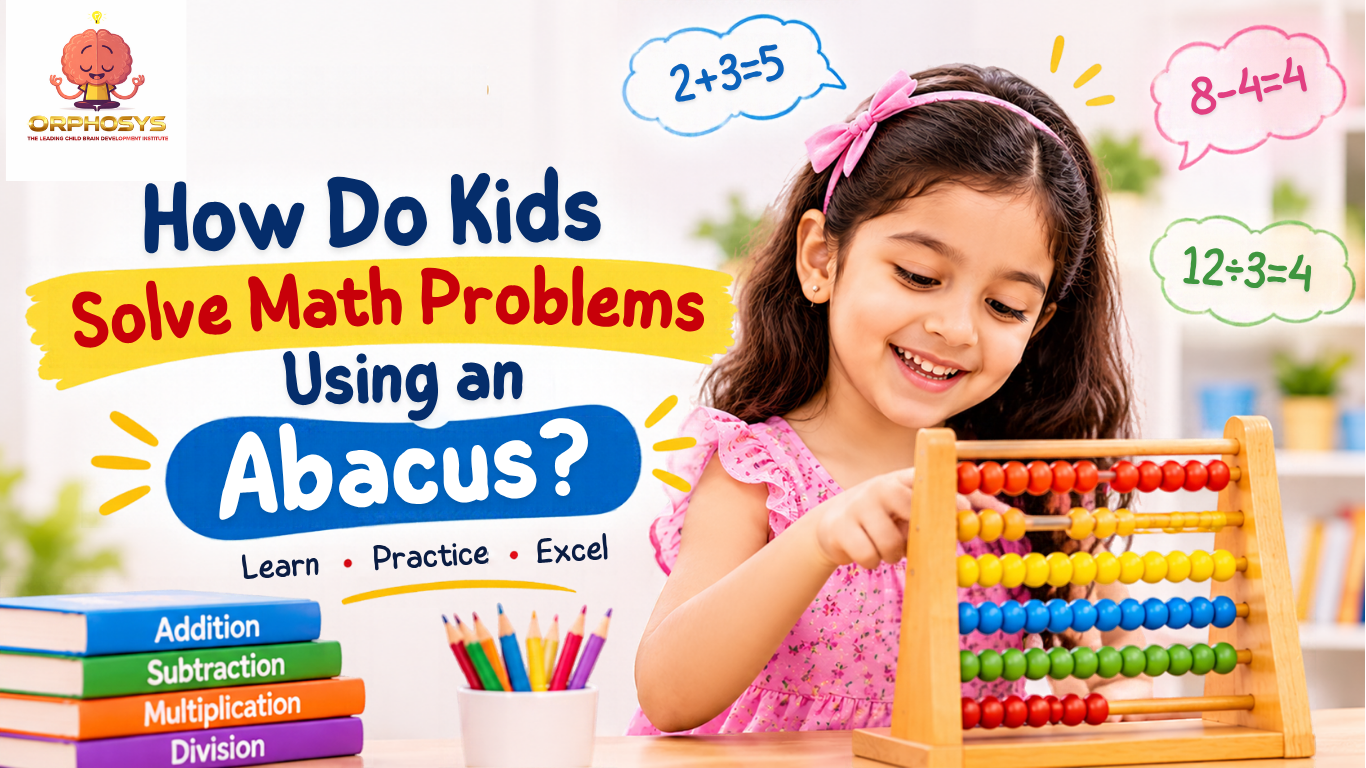
Mathematics is an important part of every child's education. However, many children find calculations difficult when they are first introduced to numbers. Learning mathematics through visual tools and practical activities can make the process easier and more enjoyable. One such effective learning tool is the abacus.
An abacus is a traditional counting instrument that helps children understand numbers and perform mathematical calculations. It uses beads arranged on rods to represent numerical values. By moving these beads, children can learn addition, subtraction, multiplication, and division in a simple and interactive way.
Today, abacus learning is becoming popular among parents who want to make mathematics more interesting for their children. Let's explore how kids use this amazing learning tool to solve mathematical problems.
What Is an Abacus?
An abacus is a mathematical tool made up of a frame, rods, and movable beads. Each rod represents a particular place value, such as ones, tens, hundreds, and thousands.
Children move the beads to represent different numbers and perform calculations. This hands-on learning method helps them understand how numbers work instead of simply memorizing mathematical rules.
For example, when a child wants to represent the number 25, they can move two beads in the tens column and five beads in the ones column.
This visual representation makes it easier for children to understand place value and numerical relationships.
How Do Kids Solve Addition Using an Abacus?
Addition is one of the first mathematical operations children learn with an abacus.
Let's understand with a simple example:
Example: 12 + 5 = 17
Step 1: Represent the number 12 by moving one bead in the tens column and two beads in the ones column.
Step 2: Add five more beads in the ones column.
Step 3: Count the beads to get the final answer.
The result is 17.
Through this method, children can understand how numbers increase when they add more quantities.
With regular practice, children become more comfortable with addition and can gradually solve larger calculations.
How Do Kids Solve Subtraction Using an Abacus?
Subtraction means taking away a quantity from a number. An abacus makes this concept easier to understand because children can physically move beads away.
Let's look at an example:
Example: 18 - 6 = 12
Step 1: Represent the number 18 using one bead in the tens column and eight beads in the ones column.
Step 2: Remove six beads from the ones column.
Step 3: Count the remaining beads.
The final answer is 12.
This practical activity helps children understand the meaning of subtraction and improves their confidence in solving mathematical problems.
How Do Kids Learn Multiplication Using an Abacus?
Multiplication is another important mathematical operation that children can practice using an abacus.
Multiplication is based on repeated addition.
For example:
Example: 3 × 4 = 12
This means adding 4 three times:
4 + 4 + 4 = 12
Children can use beads to represent each group and count the total number of beads.
This method helps them understand the relationship between multiplication and addition.
As children become more experienced, they can learn more advanced multiplication techniques and solve larger numbers.
How Do Kids Learn Division Using an Abacus?
Division means splitting a number into equal groups.
An abacus can help children understand this concept through visual representation.
For example:
Example: 12 ÷ 3 = 4
Imagine that a child has 12 beads and wants to divide them into three equal groups.
By distributing the beads equally, each group receives four beads.
Therefore, the answer is 4.
This activity helps children understand division in a practical way instead of relying only on memorization.
How Does Abacus Learning Help Children Understand Mathematics?
Learning mathematics becomes easier when children can see and interact with numbers.
An abacus provides a visual and practical learning experience that can support mathematical understanding.
Here are some important benefits:
1. Better Understanding of Numbers
Children can see how numbers are represented through beads. This helps them understand counting, place value, and basic mathematical operations.
2. Improved Calculation Skills
Regular practice helps children become more familiar with mathematical calculations. They can gradually improve their speed and accuracy.
3. Stronger Problem-Solving Skills
Children learn to follow steps and think logically while solving mathematical problems. This can support their overall learning experience.
4. Increased Confidence
When children successfully solve calculations, they feel more confident about mathematics. This positive experience can encourage them to practice more.
5. Enjoyable Learning Experience
Moving beads and solving number problems can make mathematics feel like an interactive activity rather than a difficult subject.
Can Children Learn Abacus Through Digital Apps?
Yes! Digital learning has made mathematics more accessible to children.
Today, children can practice mathematical calculations using interactive learning applications. These applications may include visual demonstrations, guided lessons, practice activities, and progress tracking.
Orphosys Abacus provides a digital learning experience that helps children explore mathematical concepts in an engaging way.
With regular practice, children can become more familiar with numbers and develop their calculation skills.
Parents can encourage their children to practice daily and make mathematics a part of their everyday learning routine.
Conclusion
An abacus is a useful mathematical learning tool that helps children understand numbers through visual representation and practical activities.
From addition and subtraction to multiplication and division, children can use this tool to explore different mathematical concepts step by step.
With consistent practice, children can improve their calculation skills, develop confidence, and enjoy learning mathematics.
If you want to introduce your child to an engaging way of learning mathematics, abacus learning can be a great starting point.
Explore Orphosys Abacus and make your child's mathematics learning journey more interactive, enjoyable, and meaningful.
Start learning mathematics the smart way with Orphosys Abacus!